Dalek Cluster
Info
A working paper describing the Dalek cluster philosophy is available on arXiv and HAL. If you are using Dalek for research, please cite this document: "Dalek: An Unconventional and Energy-aware Heterogeneous Cluster" [doi] [pdf] [slides].
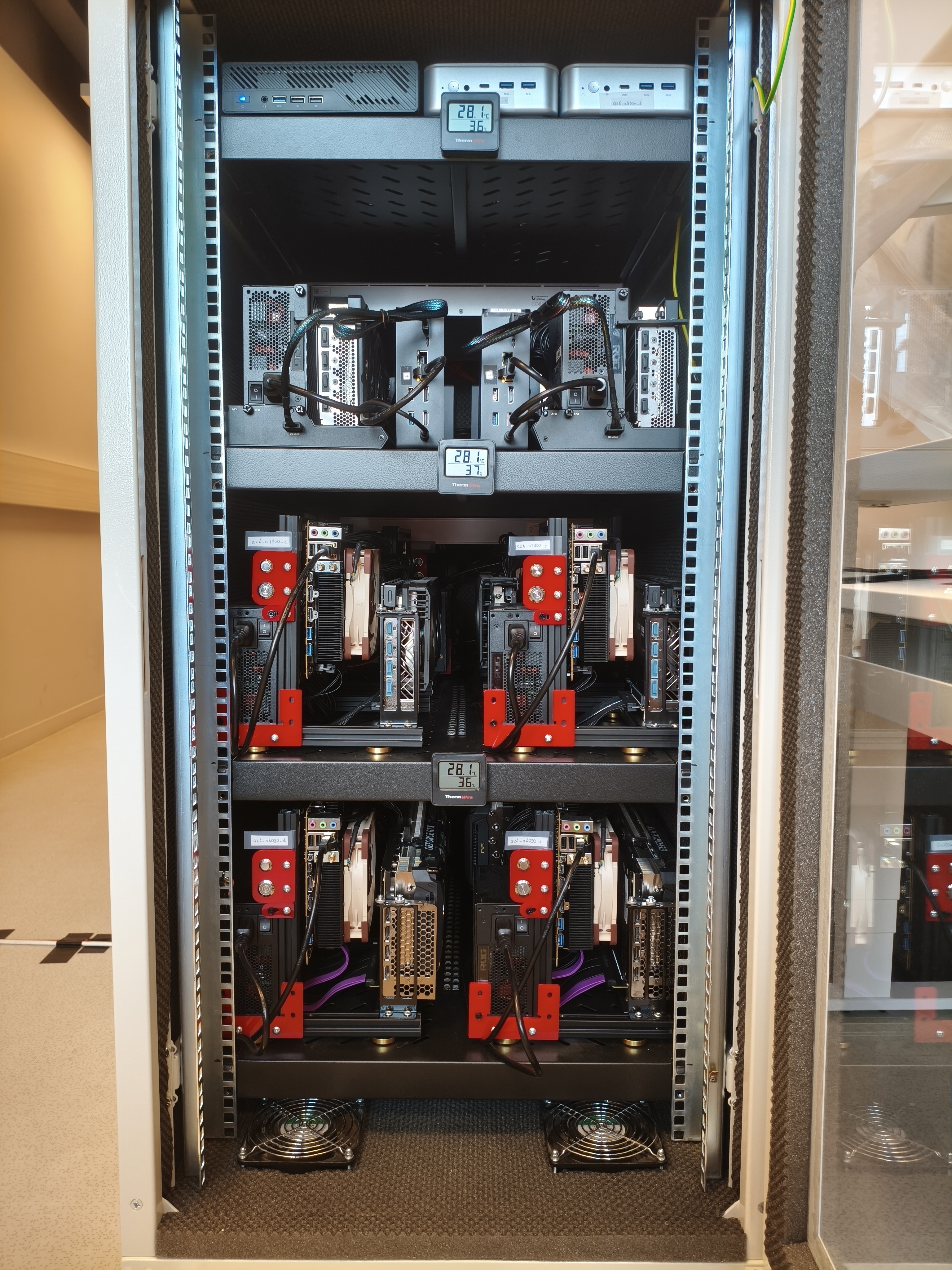
Dalek is an unconventional, energy-aware heterogeneous cluster designed for rapid software prototyping and reproducible energy-efficiency measurements. By leveraging consumer-grade hardware (mini-PCs, MoDT motherboards, SBCs, and gaming GPUs) instead of costly server-class components, Dalek provides direct access to cutting-edge architectures at a moderate price.
🔌 Fine-Grained Energy Monitoring
Every compute node in Dalek is equipped with Node-Conso Modular (NCM), a custom open-source hardware and software platform.
- Physical Measurement: Captures real power usage directly between the PSU and components (not software estimations).
- High Frequency: 1,000 to 5,000 samples per second.
- Component-level: Independent monitoring of CPU, GPU, and motherboard power rails.
💻 Hardware Diversity & Accessibility
Dalek serves as a sandbox for modern consumer architectures:
- Heterogeneous SoCs: x86 Intel and AMD processors featuring hybrid performance/efficient (P/E/LP) cores and integrated NPUs for local AI/DNN inference.
- Multi-vendor Accelerators: A broad mix of consumer-grade Nvidia, AMD, and Intel GPUs—a cost-effective playground for deep learning prototyping.
🧪 Multi-Layer Software Co-design
The cluster's architecture allows developers to optimize software across multiple boundaries:
- Core-level instructions and hybrid execution (P/E cores).
- Distributed parallel computing (4-node partitions connected via 2.5 GbE).
- Memory architectures and real-time energy profiles.
📟 Embedded Systems Prototyping
The Monolithe rack extends Dalek with a curated collection of Single Board Computers (SBCs) targeting embedded and edge computing research:
- Architectural breadth: ARM (Cortex-A, Nvidia Jetson), RISC-V (SpacemiT K1, K3), and x86 SoCs — all under the same SLURM instance and with a shared file system.
- Energy measurement: Each SBC is connected to NCM, an open and specific energy measurement board that captures voltage, current and power at up to 5,000 samples/s.
- Use case: Evaluate the suitability of heterogeneous SoCs for embedded applications (satellites, edge AI, network equipment) and compare programming models across a wide variety of architectures.
This project has been carried out with financial support from the French State, managed by the French "Agence Innovation Défense".